The Origins of Yang-style Old Frame and Its Connection to Modern Tai Chi
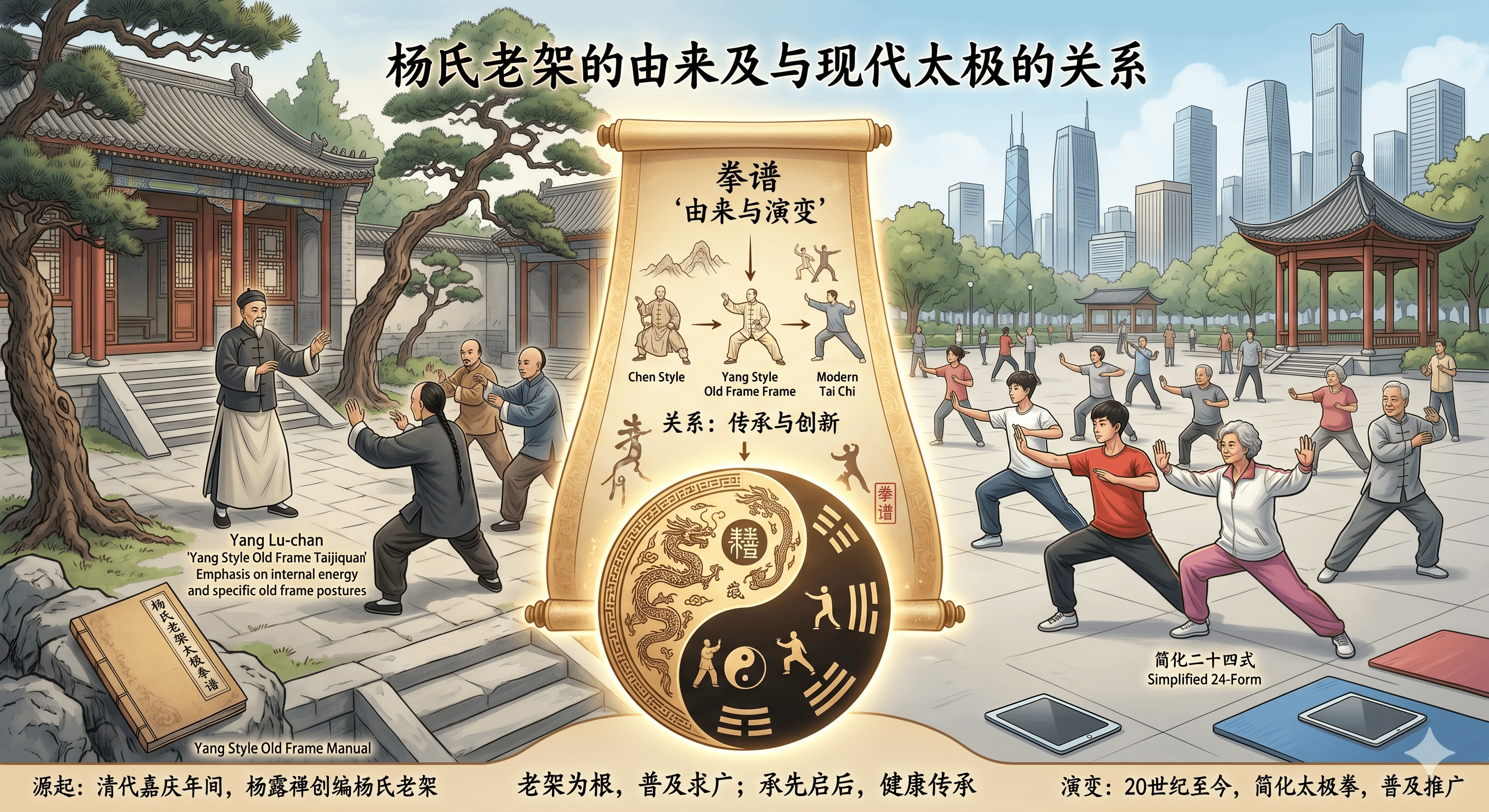
1. How Yang-style came from Chen-style
●Yang Luchan (1799–1872), originally from Guangping Prefecture in Hebei (today’s Yongnian, Handan), went to Chen Village to study martial arts. At that time, Chen Changxing was the main inheritor, teaching Chen-style Taiji, Old Frame First Routine. ●After Yang mastered it, he went back to his hometown to teach, and later worked in a royal household in Beijing as a martial instructor. Whenever Yang competed, he always won, earning the nickname “Yang the Invincible.” ●Because the nobles and officials in Beijing weren’t strong farmers like in Chen Village, Yang adjusted the style. He removed the explosive “cannon fists” and fast, hard movements, turning them into softer, rounder, more continuous motions — easier for different body types to practice. ●A famous scholar, Weng Tonghe(he was Emperor Guangxu’s tutor during the Qing Dynasty), once watched Yang in action and praised him: “Advancing and retreating with lightning speed, solid and empty impossible to predict; body like an agile ape, hands moving like a rolling ball — the whole form like Taiji itself, unified and complete.” He even wrote a couplet for Yang: “With Taiji in hand, you embrace the whole world; with supreme skill, you stand above all others.” ●This became the foundation of Yang-style Taiji. So, Chen-style is like the “grandfather,” Yang-style the “grandson”: Yang came from Chen, but developed along a different path.
2. What “Old Frame” means
●The term “old frame” can be confusing, since Chen-style also has an Old Frame First Routine. ●In Yang-style, “old frame” refers to the original sets passed down from Yang Luchan, Yang Jianhou, and Yang Shaohou. These routines kept more of the complete movements, the ‘drawing-out, silk-like’ type of energy, and the sense of attack and defense. ●Later, Yang Chengfu (Luchan’s grandson) promoted Taiji in the early 20th century. To make it more accessible, he simplified and enlarged the movements, removing many small variations, and made the postures broader and more open. This became the widely practiced “Yang Chengfu New Frame.”
3. The birth of Simplified Yang-style
●After the Republic of China was founded, the government wanted to promote martial arts nationwide. Yang Chengfu was invited to teach in cities like Nanjing and Shanghai. To allow more ordinary people — including the elderly and women — to practice, he made the forms even simpler. ●In the 1950s, the Chinese Sports Committee further trimmed Yang Chengfu’s set into the 24-Form Simplified Taiji, which became the standardized routine across the country. ●That’s why when many people today say “Taiji,” what they actually mean is this simplified Yang-style.
4. Features of the Old Frame
●Compared to the new frame and simplified sets, the old frame has more movements, more subtle changes, and more martial applications. ●The rhythm is not just slow — it has gathering and releasing, fast and slow, open and closed. ●Yang-style Taiji emphasizes chousi jin — a ‘drawing-out, silk-like’ type of energy — whereas Chen-style Taiji uses chansi jin, the traditional ‘silk-reeling’ energy, with clear offensive and defensive ideas. Every posture has a fighting or neutralizing function. ●It’s harder to learn, but much richer in martial flavor. That’s why masters like Ji Peigang and Wang Yongquan always emphasized its importance.
In short:
👉 Chen-style → Yang Luchan → Yang-style Old Frame (practical, original form) → Yang Chengfu’s New Frame (big, open, good for spreading) → Simplified 24-Form (mainly for health). If you really want to develop deep skill, the key lies in the old frame — not just stopping at the simplified version.