
The difference between Tai Chi, internal strength, aerobics, and ordinary exercise
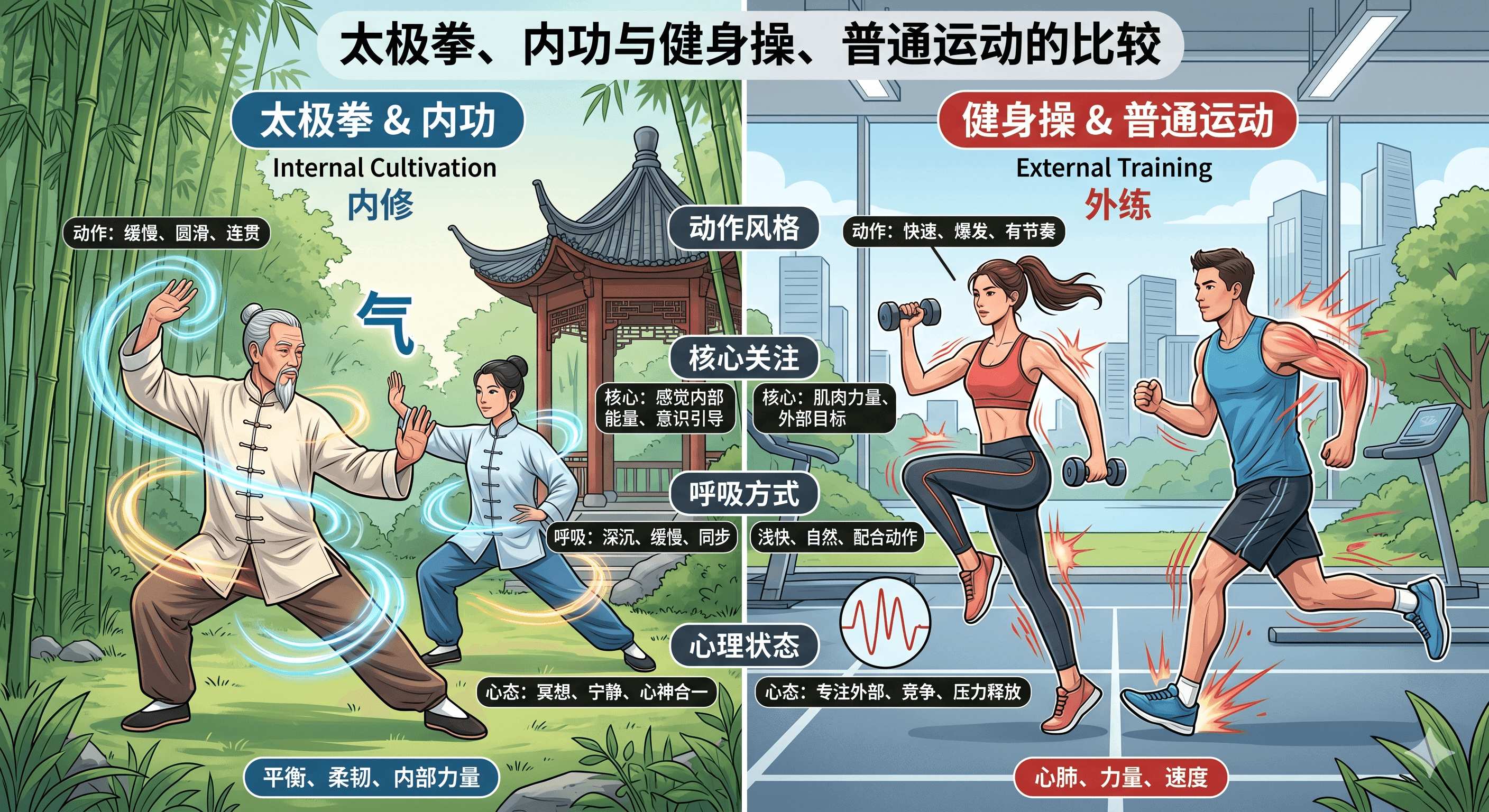
1. Power Generation
●Tai Chi / Internal Training: ○Trains power from the inside out — force is generated from the feet → legs → hips → spine → shoulders → hands. ○Emphasizes relaxation, storing energy, spiral transmission, and sudden explosive release (fajin). ○Uses whole-body coordination and can redirect or borrow the opponent’s force — not just brute muscle strength. ●Aerobics / Regular Exercise: ○Power comes mainly from isolated muscle contractions. ○Movements are direct and rely on immediate exertion — no store–transfer–release chain.
2. Self-Defense Capability
●Tai Chi / Internal Training: ○Has a systematic framework for defense, neutralization, and counterattack, especially through push hands practice. ○Uses “listening to force” (tingjin), “neutralizing” (huajin), and “issuing” (fajin) to protect oneself and control the opponent. ○Trains skills for close-range and reactive situations. ●Aerobics / Regular Exercise: ○Not designed for fighting or self-defense. ○May improve fitness but offers no combat strategy or application.
3. Health Benefits
●Tai Chi / Internal Training: ○Low to moderate intensity, sustainable for long practice sessions. ○Improves breathing, circulation, joint flexibility, and nervous system balance. ○Helpful for chronic condition recovery, posture correction, and emotional stability. ●Aerobics / Regular Exercise: ○Focuses more on cardiovascular fitness, muscle strength, and body shape. ○Boosts metabolism quickly, but does less for deep joint and fascia conditioning.
4. Mental & Emotional Connection
●Tai Chi / Internal Training: ○Combines movement and intention — “use the mind to guide the qi, and the qi to move the body.” ○Meditative nature cultivates focus, calmness, and sensitivity. ○Reduces stress by actively training awareness, not just by burning off energy. ●Aerobics / Regular Exercise: ○Focus is usually on pace, heart rate, and calorie burn. ○Mental benefits come from post-exercise endorphin release, not intentional awareness training.
5. Movement Structure & Time Scale
●Tai Chi / Internal Training: ○Slow, continuous, and refined — with internal changes in tension, relaxation, expansion, and contraction. ○A single form can be studied for years, each move having multiple training layers. ●Aerobics / Regular Exercise: ○Fast-paced, repetitive, with shorter training cycles (weeks to months). ○Progression comes from adding weight, speed, or changing movements.
6. Long-Term Effects
●Tai Chi / Internal Training: ○Skill can keep improving with age; peak performance often occurs in middle or later years. ○Internal skill development can influence lifestyle, mindset, and even slow aging. ●Aerobics / Regular Exercise: ○Declines more sharply with age due to joint load and intensity requirements. ○Limited impact on deeper mental or lifestyle transformation.
One-Sentence Summary:
Tai Chi with internal training is “cultivating force through relaxation, guiding movement with intent, and nourishing spirit through form” — a whole-person discipline. Regular exercise is “shaping the body, boosting capacity, and trading sweat for health” — an external workout.
Comments
Only signed-in members can comment. Comments appear immediately; the team may hide spam or abuse later.
…