
The 5 Core Pillars of Yang-Style Tai Chi
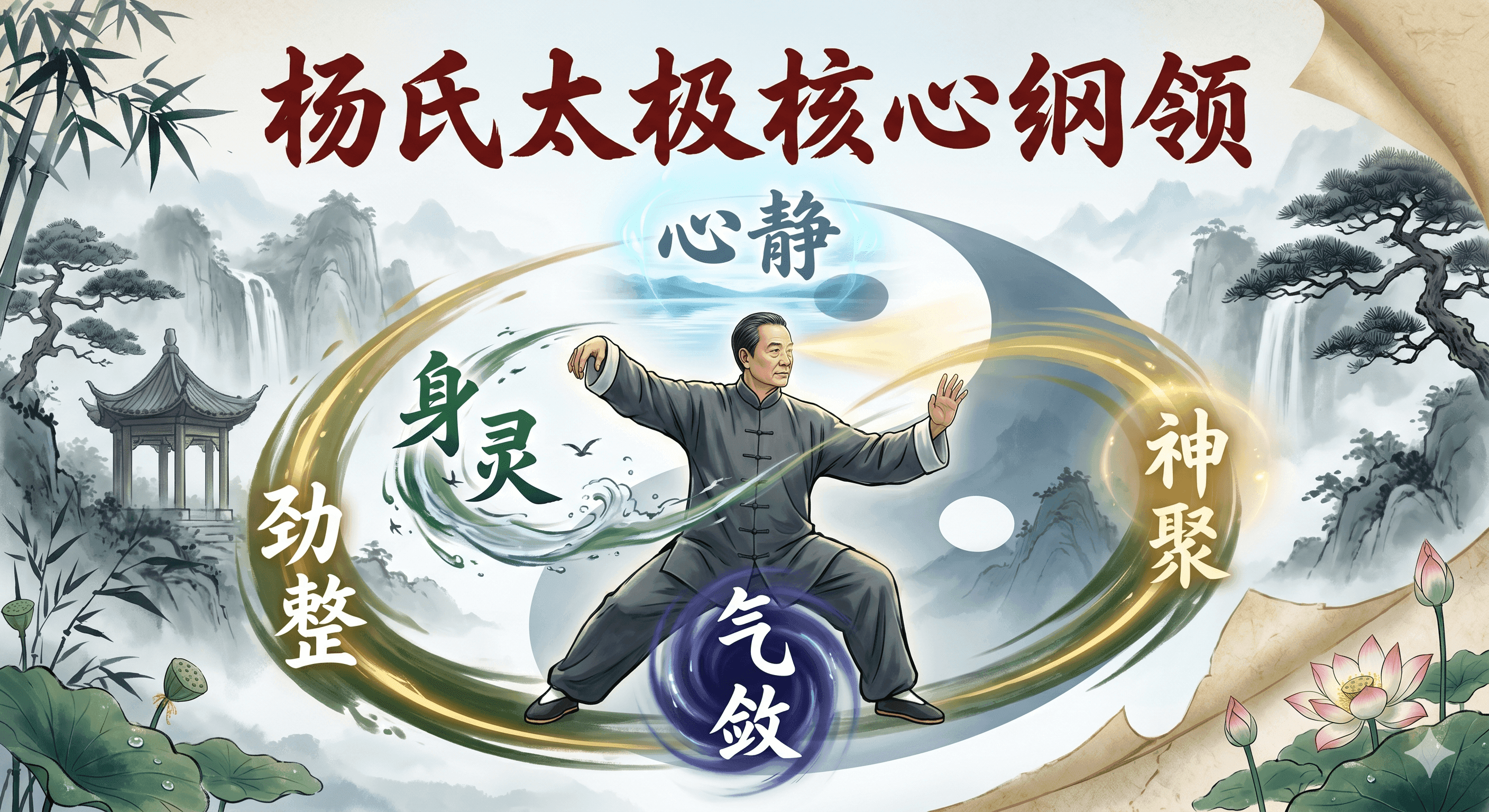
The 5 Core Pillars of Yang-Style Tai Chi
[A Calm Mind, An Agile Body, Gathered Qi, Integrated Power, Focused Presence]
These five essentials form the heart of Yang-style Tai Chi training. They are not just rules for movement, but a complete system of internal cultivation—transforming you from the inside out, bridging mindfulness, health, and martial art.
1. A Calm Mind (心靜 - Xin Jing)
●The Concept: Inner peace, mental stillness, and a mind free of clutter. ●The Deep Dive: This is ground zero for all Tai Chi practice. Before you move your body, you must settle your mind. ○Internally: Check your ego, daily worries, and the urge to "win" at the door. Enter a state of relaxed focus. Think of your mind as a still lake, perfectly reflecting everything around it. ○Externally: In Push Hands (Tui Shou) or martial applications, a calm mind allows you to truly "listen" (Ting Jin)—physically sensing your opponent's force, direction, and balance. A restless mind leads to a stiff body, leaving you vulnerable. ○How to Practice: Use the slow, continuous movements and your breathing as an anchor. Let the physical flow wash away scattered thoughts. It is, essentially, moving meditation.
2. An Agile Body (身靈 - Shen Ling)
●The Concept: A physical state that is light, nimble, and deeply relaxed. ●The Deep Dive: Built on a calm mind, this is about unlocking the body through active relaxation (Song). ○Relaxed, not collapsed: This isn't about being limp. It’s about releasing unnecessary muscular tension, unlocking the joints, and opening the fascia. Your body becomes a highly responsive, flexible system. ○Seamless transitions: Only an agile body can shift weight and change direction without a hitch. The classic Tai Chi saying describes this extreme sensitivity perfectly: "So balanced and light that the weight of a single feather cannot be added, nor can a fly alight on you without setting you in motion." ○How to Practice: Follow the structural alignments—sink the shoulders, drop the elbows, hollow the chest, gently open the back, and relax the hips. Scan your body during every posture to find and melt away stiffness.
3. Gathered Qi (氣斂 - Qi Lian)
●The Concept: Internal energy collected and rooted in the lower abdomen (Dantian). ●The Deep Dive: "Qi" is your vital energy or internal sense of flow. When you are stressed, this energy scatters outward and upward. When you are calm and relaxed, it naturally condenses and sinks. ○Sinking Qi to the Dantian: Through deep, diaphragmatic breathing, you guide this energetic feeling down to your lower belly. This drops your center of gravity, builds internal fullness, and primes the body to generate power. ○Absorbing into the bones: At an advanced level, this energy is drawn deep into the bones and marrow rather than floating on the surface of the skin. This creates a deeply resilient and unified body. ○How to Practice: Marry your breath to your movement. Inhale as you open or store energy; exhale as you close or release. Over time, the movement and the breath become one.
4. Integrated Power (勁整 - Jin Zheng)
●The Concept: Whole-body, unified kinetic power. ●The Deep Dive: This is Tai Chi’s signature way of moving, fundamentally different from isolated muscular force. Jin is the coordinated, explosive energy of the entire system. ○The Kinetic Chain: Power is rooted in the feet, powered by the legs, steered by the waist, and expressed through the hands. Like a whip, the energy starts at the base and surges outward in one unbroken wave. ○Elastic release: True Tai Chi power relies on supreme relaxation. It is a sudden, spring-like release—fast, penetrating, and rebounding, rather than a stiff, brute-force shove. ○How to Practice: Use standing meditation (Zhan Zhuang) and single-movement drills to physically feel the ground reaction force travel up from your feet, twist through your hips, and exit through your arms.
5. Focused Presence (神聚 - Shen Ju)
●The Concept: Concentrated spirit and unwavering intention. ●The Deep Dive: This is the pinnacle of the practice, seamlessly weaving the first four pillars together. ○Inner and Outer Unity: When the mind is calm, the body agile, the Qi gathered, and the power integrated, your "Spirit" naturally focuses. Your gaze, intention, and breath align perfectly with your physical form. ○A commanding presence: When your spirit is focused, your energy fills the space. It’s not aggressive; rather, it’s a feeling of being grounded, centered, and immovable. In martial arts, this creates an invisible psychological pressure on the opponent. ○How to Practice: Keep your intention sharp from the first movement to the last. Transform the quiet emptiness of the "Calm Mind" into the rich fullness of "Focused Presence." As the masters say: "The physical movement may pause, but the intention continues; the intention may pause, but the spirit remains connected."
Conclusion: The Five Pillars as One Living System
These five pillars do not exist in isolation. They form an interconnected, living system where each principle naturally feeds into the next: ●You must begin with a Calm Mind to unlock an Agile Body. ●Only through an Agile Body can you cultivate Gathered Qi. ●Once your Qi is gathered and rooted, you can generate Integrated Power. ●Ultimately, all of these elements must be guided by a Focused Presence to reach their full potential. Training in Yang-style Tai Chi is a continuous journey of polishing and deepening your experience across these five layers. It is much more than a martial art; it is a profound philosophy of life—a harmonious blend of stillness and motion, and the ultimate unification of mind and body.
Comments
Only signed-in members can comment. Comments appear immediately; the team may hide spam or abuse later.
…