Shen, Yi and Qi: Traditional and Modern Interpretations of Tai Chi and Qigong
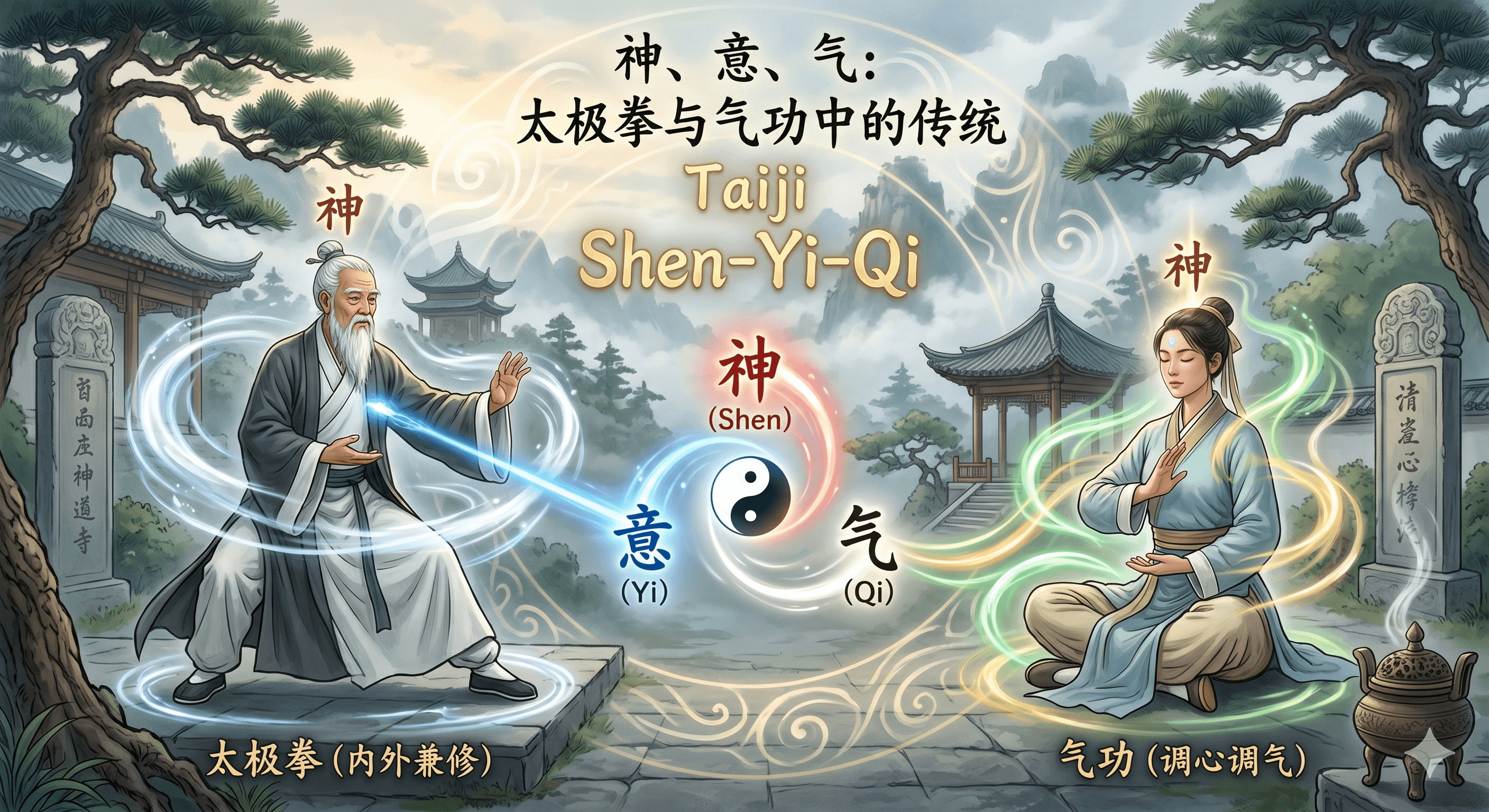
Understanding “Shen, Yi, Qi” in Tai Chi and Qigong: Traditional and Modern Perspectives In traditional Chinese internal arts, Shen (Spirit), Yi (Intent), and Qi (Energy) are central concepts guiding practice. These three elements work in harmony: Shen directs Yi, Yi guides Qi, and Qi flows through the body to produce movement and power. While classical texts describe them in metaphysical terms, modern interpretations attempt to explain these phenomena using physiological, psychological, and even physical theories.
1. Wang Weigong — “Qi as Musical Patterns”
Wang Weigong, a qigong researcher with a musical background, conceptualizes Qi as an internal pattern of vibrations or rhythms, much like a musical score. According to his view, breathing, circulation, and muscle tension all follow cyclical rhythms. Training in Tai Chi or Qigong involves consciously regulating these rhythms using mental focus, thereby achieving a coordinated system-wide flow. Qi, in this perspective, is not mystical, but a perceptible and adjustable dynamic pattern within the body.
2. Li Sichen (Former President of National Taiwan University) — Mind-Body Coordination
Li Sichen approached Qigong from a scientific perspective, integrating physiology, neuroscience, and psychology. His research emphasizes that: ●Coordinated breathing and movement regulate the autonomic nervous system, balancing sympathetic and parasympathetic activity. ●Intentional guidance of movement stabilizes brainwave patterns and enhances neural coordination. ●Muscle tone and joint mechanics adapt, creating more efficient force transmission and body alignment. In this framework, the “Qi sensation” is the quantifiable outcome of mind-body coordination, rather than an invisible force.
3. David Bohm — Quantum Order
Physicist David Bohm’s implicate order theory in quantum mechanics posits a deep, underlying order in the universe, where local phenomena are projections of a broader, hidden structure. Applied metaphorically to Tai Chi and Qigong: ●Qi can be understood as a dynamic flow within this hidden order, perceivable through the body. ●Yi represents the intentional guidance toward this order. ●Shen corresponds to the conscious awareness that unifies perception and action. Bohm’s view provides a scientific and theoretical lens to interpret traditional concepts in a modern context.
Converging Insights: Shen, Yi, Qi Today
Across these perspectives, several common points emerge: ●Shen (Spirit): Consciousness or awareness directing movement, rhythm, and coordination. ●Yi (Intent): Mental focus that guides Qi and organizes bodily action. ●Qi (Energy): A dynamic flow, vibrational pattern, or integrative life force produced by mind-body coordination.
Modern interpretations consistently emphasize that Qi is not a mystical force but a perceptible, regulatable phenomenon. The practice of Tai Chi and Qigong is fundamentally about using Shen to govern Yi, and using Yi to guide Qi, thereby achieving a state of integrated, holistic body-mind functioning.